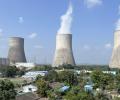
In a significant move, the United States on Wednesday removed restrictions on three Indian nuclear entities, over a week after National Security Advisor Jake Sullivan announced that Washington was finalising steps to 'remove' hurdles for civil nuclear partnership between Indian and American firms.
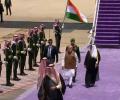
Modi and the Crown Prince will co-chair the second meeting of the Strategic Partnership Council, established during the prime minister's 2019 visit to strengthen bilateral ties.

The biennial tri-services exercise, Bright-Star, is taking place at Cairo (West) Air Base and it is being participated by militaries of the US, Saudi Arabia, Greece and Qatar besides of the host country and India, officials said.
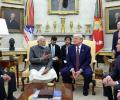
India and the United States have agreed to deepen their strategic partnership in several key areas, with President Donald Trump announcing plans to provide India with F-35 fighter jets and billions of dollars in military supplies. The two leaders also discussed energy cooperation, critical technologies, connectivity, and countering terrorism. They agreed to work together on the India-Middle East-Europe Economic Corridor, and Trump noted India's reforms to welcome US nuclear technologies. Prime Minister Modi said the two countries can shape a better world through their cooperation. Both leaders also addressed the Russia-Ukraine conflict, with Modi stressing India's commitment to peace.

'...it should not delude itself into thinking that India's security or its great-power ambitions will be advanced by those partnerships.'
'Instead, what India should focus on is on riding out the next three-and-a-half years of Trump's presidency with minimal damage to itself.'

Russian President Vladimir Putin briefed Prime Minister Narendra Modi on his summit talks with US President Donald Trump on ending the war in Ukraine.
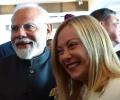
Prime Minister Narendra Modi held a series of bilateral meetings with his global counterparts on the margins of the G7 Summit in Kananaskis, with discussions focusing on a range of issues such as trade, investment, counter-terrorism and global challenges.
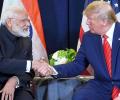
It would be the prime minister's first bilateral visit to the US after Trump became president for a second term.
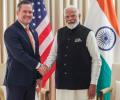
Prime Minister Narendra Modi said he had a 'fruitful meeting' with United States National Security Advisor Michael Waltz and they discussed defence, technology and security areas, which are important aspects of the India-US ties.
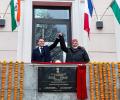
Prime Minister Narendra Modi and French President Emmanuel Macron have called for enhancing trade and investment ties between their countries and committed to further deepening their engagement in the Indo-Pacific. They discussed a full spectrum of bilateral relations, including key global and regional issues, and stressed the urgent need for reform in the United Nations Security Council. The leaders also underscored their commitment to ensuring the global AI sector can drive positive social, economic, and environmental outcomes.

India and the United States have announced a groundbreaking 10-year defence partnership, paving the way for increased military cooperation and potential sales of F-35 stealth fighter jets. The agreement aims to bolster both countries' defence capabilities in the Indo-Pacific region, with plans for joint production of weapons and platforms. The move comes amid China's growing military presence in the region.
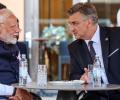
In his media statement following talks with his Croatian counterpart Andrej Plenkovic, Modi said both leaders agree that "terrorism is an enemy of humanity" and is inimical to forces that believe in democracy.

Their shared brief: To assert India's case with clarity, rebut hostile narratives, and secure enduring partnerships for global counter-terror cooperation.
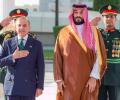
'Saudi-Pak defence pact is to anchor the defence and security of Saudi Arabia and not Pakistan, per se, with Islamabad being the junior partner.'

The prime minister said that India has invited Germany to take advantage of opportunities in defence production in the defence corridors in Uttar Pradesh and Tamil Nadu.
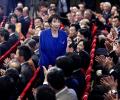
As a protege of Shinzo Abe, Takaichi is expected to scale bilateral ties much higher. Trade and investment shall grow. People-to-people contacts shall be scaled up, points out Dr Rajaram Panda.

Australian Deputy PM Marles to watch India-Australia World Cup cricket final in Ahmedabad
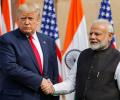
The China threat continues to resonate in the strategic partnership between India and the USA, points out Rup Narayan Das.

The Crown Prince of Dubai, Sheikh Hamdan bin Mohammed Al Maktoum, will visit India on April 8-9, during which he will meet Prime Minister Narendra Modi, hold talks with External Affairs Minister S Jaishankar and Defence Minister Rajnath Singh, and participate in a business roundtable seeking to bolster India-United Arab Emirates ties.
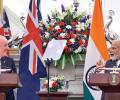
India and New Zealand have signed a pact to institutionalize their defence ties and vowed to boost cooperation in the Indo-Pacific. Prime Minister Narendra Modi raised concerns about anti-India activities by some illegal elements in New Zealand with his Kiwi counterpart Christopher Luxon. The two sides also signed six agreements to enhance cooperation in areas including education, sports, agriculture, and climate change. They also agreed to prepare a roadmap for cooperation in the defence industry sector and explore early implementation of cooperation in the digital payments sector.
Dr Jaishankar is expected to discuss the dates for the fifth Quad leaders' summit in India later this year.
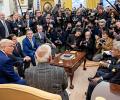
During the talks, India and the US decided to take a big leap in broad-basing their strategic ties in several critical areas.
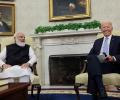
'The message that we intend to leave with at the end of this trip is one of real gratitude for the friendship and the close partnership that President Biden and Prime Minister Modi have enjoyed over the last four years, but also one of tremendous optimism because we see a lot of opportunity in the future.'

China appears determined to upgrade Pakistan's military capabilities, sufficient to ensure local parity with India, alerts former foreign secretary Ambassador Shyam Saran.
'Just as we cannot surrender the interests of our farmers and dairy industry, Trump is also looking for markets for the produce of the farmers in the Midwest, which are his support base.'

'If Washington has to balance Chinese power, she will have to turn to the third biggest power in the world which is India.' 'The United States and India will have to work together in order to keep Chinese ambitions in check.'
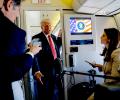
Two 'very smart' leaders of India and Pakistan decided to end last month's conflict that could have turned into a nuclear war, United States President Donald Trump said after holding a rare luncheon meeting with Pakistan army chief Field Marshal Asim Munir at the White House.

Prime Minister Narendra Modi and his Japanese counterpart Yoshihide Suga met in Washington, DC, on Thursday to discuss ways to further cement the bilateral strategic ties ahead of the first in-person Quad meeting to be hosted by US President Joe Biden.
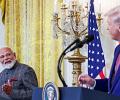
Prime Minister Narendra Modi and US President Donald Trump have vowed to move forward with plans to work together to build US-designed nuclear reactors in India. The decision was made during their meeting at the White House, where they also agreed to significantly expand energy cooperation. The move comes after India announced plans to amend its nuclear liability law and the Atomic Energy Act, which had previously been obstacles to the implementation of the US-India civil nuclear deal.

The compulsion behind India and Japan to deepen security cooperation is in response to China's growing political and economic clout and its assertive behaviour in disputed areas. This has been the key driver for bringing both India and Japan closer in the domain of security cooperation, explains Dr Rajaram Panda.
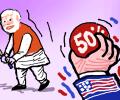
'Things may get much worse before they get better,' predicts Ajay Chhibber.
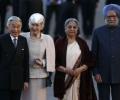
In recent years India-Japan relations have acquired rich economic content and strategic intents. Although the bilateral trade at $18 billion between the two countries is not very impressive and leaves much to be desired, the economic engagement between the two countries is both qualitatively and quantitatively noteworthy. India-Japan defence cooperation, however, has generated a lot interest among the strategic community in the context of rise of China. There has been a lot of speculation about India-Japan strategic partnership to hedge China, says Rup Narayan Das.
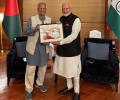
In his first meeting with Bangladesh Chief Adviser Muhammad Yunus, Prime Minister Narendra Modi on Friday flagged concerns over the attacks on minorities, including Hindus and conveyed that any rhetoric that vitiated the environment was best avoided.

China and India on Wednesday held their upgraded strategic dialogue to shore up bilateral ties amid hectic parleys to resolve differences over Beijing's reluctance to support India's bid for Nuclear Suppliers Group membership as well as a United Nations ban on JeM chief Masood Azhar.
Artificial Intelligence, innovation and next-generation technologies figured prominently during the high-stakes discussion between Prime Minister Narendra Modi and US President Donald Trump at the White House, as the two sides announced transformative measures, including the US-India TRUST initiative, roadmap on accelerating AI infrastructure and INDUS Innovation, to boost tech ties.
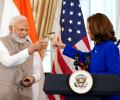
India and the US are working with renewed trust in areas of new and emerging technologies, Prime Minister Narendra Modi said on Friday as he thanked the American leadership for giving him a grand welcome.

'There is responsibility to make great games that are played by audiences, that fill the gap from an entertainment perspective.'
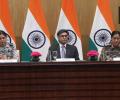
"It is shocking to note that Turkey, the second-largest arms supplier to Pakistan after China, has played a key role in modernising Pakistan's navy and enhancing its aerial warfare capabilities. "This defence collaboration is not just commercial; it is ideological, targeting the stability of South Asia and emboldening Pakistan's military adventurism," SJM national co-convenor Ashwini Mahajan said in a statement.

Continuing his fast-paced diplomacy, Indian Prime Minister Narendra Modi spoke to China's Premier Li Keqiang on Thursday. During the phone call, Li conveyed his government's desire to establish a robust partnership with the new government in India.
India on Saturday announced plans to amend its nuclear liability law and set up a nuclear energy mission, a move that came ahead of Prime Minister Narendra Modi's likely visit to the United States.
